📅 March 2026: Updated with the latest information (egg prices and supply status).
What did you do the day the egg section at the supermarket was empty?
With the effects of bird flu continuing into 2025-2026, the retail price of eggs, once known as a "model of price stability," is projected to reach record highs. It will no longer be uncommon for a pack of 10 eggs to cost over 300 yen.
At that time, Americans about 100 years ago thought this:
"If you don't have eggs, you can make it with water."
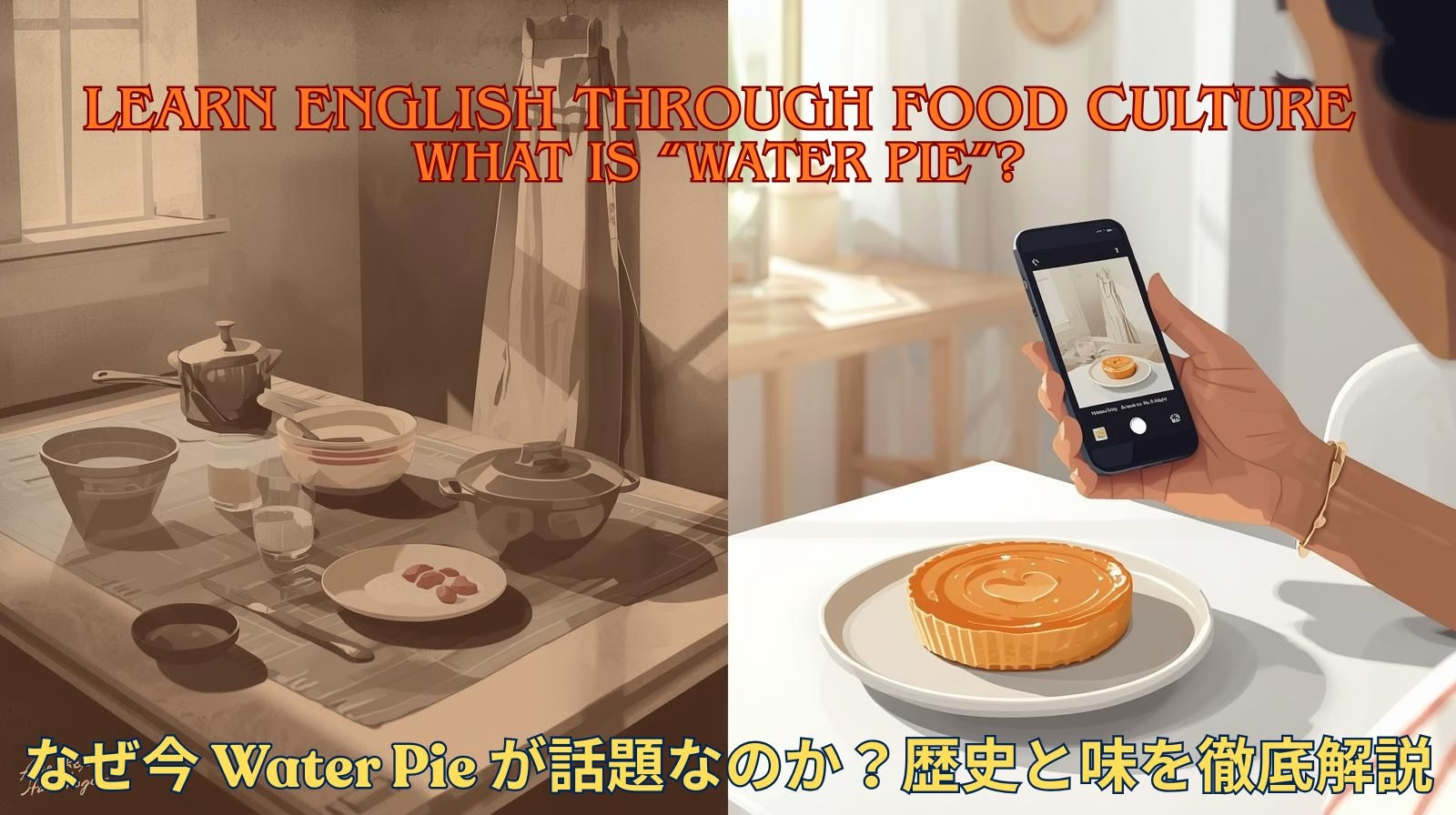
This is where the Water Pie originated. There's a reason why this recipe, born during the Great Depression, is once again gaining attention around the world.
You might be thinking, "A pie made with water?" But this isn't just a novelty dish; it's a profound creation where the history of food intersects with modern-day price issues.
This article will explain everything about Water Pie, from its origins and history to how to make it and related English phrases.
*This page contains promotional material.
table of contents
What you will learn from reading this article
What kind of food is a water pie?
Reasons and historical background for its emergence during the Great Depression
The background behind its resurgence on platforms like TikTok
Recipes you can make at home
Useful expressions for explaining in English
Real reactions from overseas reviews
What kind of food is a water pie?
Water pie is, as the name suggests, a unique pie made primarily with water. It's made with minimal ingredients—sugar, butter, flour, and water—and when baked, it becomes a jelly-like, gooey filling.
While it's often described as " custard-like" in actual overseas reviews , it's recognized more as a " historical food " than as a gourmet dish.
Pies in which water is the "main ingredient" have long been a staple of home cooking, particularly in the American South.
A video summarizing the article can be found here ↓
Why "water"? The origin and historical background of the word.
● Family circumstances during the Great Depression determined everything.
The Great Depression of 1929 caused many families to face unemployment and reduced income, making eggs, milk, and expensive butter luxuries. Cookbooks and newspapers featured many articles on "How to bake with what you have," and home-style recipes spread rapidly.
Water pie was born out of this trend.
Taste of Home describes Water Pie as "a Great Depression-era recipe made with water, sugar, flour, and butter," clearly indicating its historical context. There was a demand for a dessert that could be made with minimal ingredients—one that would set without eggs and be sweet without milk .
● The reason "water" was chosen is "because it is consistently cheap."
In rural areas of the American South at that time, well water was free and a staple in every kitchen. Sugar was also relatively inexpensive and had a long shelf life, so combining them made it possible to create " authentic-looking sweet dishes ."
Furthermore, since the cake flour served both the roles of thickening and solidifying, it was possible to recreate a "custard-like" texture even with water. It was a very rational choice as a substitute during a time of high egg prices.
● How the recipe spread: Primarily through churches and communities
At the time, "Church Cookbooks" had more influence than regular cookbooks . These were booklets compiled by local women featuring home-style recipes, and Water Pie was one of the recipes that was passed down through generations.
In other words, water was chosen not because it was "special," but because it is "a material that is found in every home ." This rationalism is the defining characteristic of Water Pie.
Other budget-friendly sweets that emerged around the same time include "Vinegar pie" and "Chess pie."
🇯🇵 Japan in 2025-2026, for some reason, is linked to this.
Actually, this story feels very real even in Japan today.
Due to the continued spread of avian influenza, the average nationwide retail price of a 10-pack reached a record high by the end of 2025 (approximately 256 yen). Prices remained high as of February 2026, with a full recovery in supply not expected until around spring 2026 (according to data from the Ministry of Agriculture, Forestry and Fisheries).
A serious situation has arisen across 32 prefectures in Japan, resulting in the culling of approximately 1,700 million laying hens. Supermarket shelves have been emptied in some areas, and convenience stores have stopped offering egg products. Furthermore, with soaring feed prices and a weak yen, some in the industry are saying that "the days of cheap eggs may never return."
The background behind the creation of Water Pie and the "anxiety about eggs" that we feel today strangely overlap, after about 100 years.
Why did a budget-friendly recipe from the Great Depression era become so popular today?
There are three main reasons why Water Pie has become popular again on social media in recent years.
① Attention to retro recipes (Great Depression recipes): Videos of people trying to recreate dishes from the Great Depression era have been posted one after another on TikTok, and Water Pie has become an iconic example of this trend.
② Resonance with the "current reality" of high prices and egg shortages: The surge in egg prices in 2025-2026 is a global phenomenon, not just limited to Japan. In the United States, egg prices have also risen to record levels due to the bird flu, bringing renewed attention to "desserts that can be made without eggs." The spirit of frugality, of "making things with only what you have at home," remains unchanged from 100 years ago to the present.
③ The intrigue surrounding the experimental dessert, specifically the question "Can water really be turned into a pie?", attracted viewers, and the hashtag "#waterpie" reached tens of millions of views on English-speaking TikTok. The positive and negative reactions continue to fuel further virality.
Current trends: TikTok and the revival of retro recipes
Water pie is also a symbol of the "retro dessert revival." Along with banana bread, cream puffs, and milk pot pie, it has ridden the wave of popularity for its "old-fashioned, inexpensive recipes."
As a result, cooking YouTubers all picked it up, and the resulting mixed reactions—some saying it was "better than I imagined" and others saying it "tasted like water"—created a vicious cycle of further virality.
In English-speaking countries, the category name "Depression-era recipes" has become well-established.
*Note: Water pie recipes vary slightly from household to household. Here, we introduce a common recipe that is popular on social media.
Ingredients (1 hole)
3/4 cup granulated sugar
1 and 1/2 cups of water
3-4 slices of butter
3 tablespoons of cake flour
Commercially available pie crust (unbaked)
Method
Line the mold with pie crust.
Mix the cake flour and sugar together and spread evenly on the bottom.
Gently pour in the water (the key is not to stir)..
Place the butter in several places.
Bake in a 190°C oven for about 45 minutes.
Let it cool down to room temperature, then chill it thoroughly in the refrigerator.
The water and flour harden when baked, creating a smooth, translucent filling.
What does it taste like? What's the texture like? Let's analyze overseas reviews.
Looking at reviews from English-speaking users, you'll find many comments like these:
"It tastes like a mild custard."
"Surprisingly good for something made of water."
"I'd eat it again... if I had nothing else."
In other words, it's something like a "sweets enjoyed as a conversation starter."
*Many overseas reviews have also been posted on Reddit (r/Old_Recipes / r/AskCulinary), “It tastes like mild custard.” “Surprisingly good for something made mostly of water.” You can actually hear comments like, "I'd eat it again... if I had nothing else."
Because it's not too sweet, it's said to pair perfectly with coffee.
Chunk collection
a Depression-era dessert(A dessert from the Great Depression era)
made with just water, sugar, and flour(Made only with water, sugar, and flour)
a retro recipe that went viral on TikTok(Retro recipes that went viral on TikTok)
custard-like texture(It has a custard-like texture.)
Super health-friendly dessert(Super budget-friendly dessert)
Examples of output you can use on social media!
1. When commenting on someone's post
If you come across a Water Pie video from overseas, why not try reacting like this?
“I've always been curious about this Depression-era dessert. Is it really custard-like?” (I've always been curious about this dessert from the Great Depression era. Is it really like custard?)
“It's amazing how such simple ingredients can turn into a pie. I'd love to try making it!” (I'm surprised that such simple ingredients can be used to make a pie. I want to try making it myself!)
2. When you create something yourself and upload the photo.
When you actually try it, try adding a caption like this along with the hashtag.
“Tried the viral Water Pie from TikTok! 🥧 It's super budget-friendly and has a surprisingly mild sweetness.” (I tried making Water Pie, which is trending on TikTok! It's super cheap to make and has an incredibly mild sweetness.)
“Made a vintage Water Pie tonight. It turns out water can actually become a dessert! 😂” (Tonight's dessert is retro water pie. I can't believe water can actually be a dessert! lol)
Q&A
Q1. Is it really delicious? A1. It's not too sweet and simple. While it might not appeal to everyone, it's definitely a conversation starter.
Q2. Would it taste better if I added eggs or milk? A2. Of course, it's possible. However, it will no longer be a "Water" pie, but a different kind of pie.
Q3. Can it be made with Japanese materials? A3. Yes. You can make it without any problems using store-bought pie crust and granulated sugar.
In the American South, this recipe is still passed down through generations as a family recipe.
Let's compare it with similar "budget recipes".
Vinegar pieA pie flavored with vinegar. A historical pie that was made from the American pioneering era to the Great Depression.
Chess pieA classic Southern pie made with sugar and eggs.
Sugar cream pieA specialty pie from Indiana made with only sugar and cream.
Water pie is characterized by having the fewest ingredients and being highly reproducible among these options.
Vinegar pie, in particular, is a "specialty born during the Great Depression," alongside water pie.
Water pie was a budget-friendly dessert from the Great Depression era.
The ingredients are super simple: water, sugar, flour, and butter.
Currently experiencing a resurgence in popularity on TikTok.
The flavor is a mild custard type.
In English, it can be described as a “depression-era dessert.”
Similar recipes include Vinegar pie and Chess pie.
Recipes that resonate especially now, coinciding with the historical rise in egg prices in 2025-2026.
The simplicity of water pie has something in common with learning English.
Even with "a small amount of materials," "if you keep at it, it will take shape."
Just like Water Pie proves that something meaningful can be made from almost nothing, your English grows the same way — one word, one phrase, one small step at a time.
advertisement
English Trend Wire
On X in English-speaking countries"Words that are actually gaining popularity right now",
We compile and deliver the data weekly.
This weekly membership compiles trending words on English-speaking platforms and analyzes the culture and context in which each word originated . We deliver a weekly summary of "living English" that you won't find in dictionaries, along with trend information from overseas markets for cross-border e-commerce sites.
Wire Intelligence
980 JPY(TAX+)/month
Weekly trend word analysis + trends in the cross-border e-commerce overseas market
What are the words that are currently gaining popularity in English-speaking countries?Weekly tally, explaining the culture and trends as well.
Cross-border e-commerce siteOverseas marketWe deliver the latest trends every week.
From the moment you join,All past issuesYou can read it.
If you have a note account, you can start reading immediately. You can cancel anytime.
ADVERTISEMENT
🇯🇵 Your Japanese language skills can earn you money worldwide.
The number of Japanese language learners is rapidly increasing overseas. No qualifications are required, registration is free, and you can teach at your own pace. Already, learners in over 150 countries worldwide are using italki to learn Japanese.
Apps teach vocabulary. Real teachers teach you to speak. On italki, you can book 1-on-1 lessons with native Japanese tutors from just a few dollars — no subscription needed. Trusted by learners in 150+ countries.