When your thoughts get stuck, you can say "get stuck" in English. Use this phrase to easily navigate both business and everyday life. Learn expression techniques to overcome stumbling blocks through realistic examples and etymology.
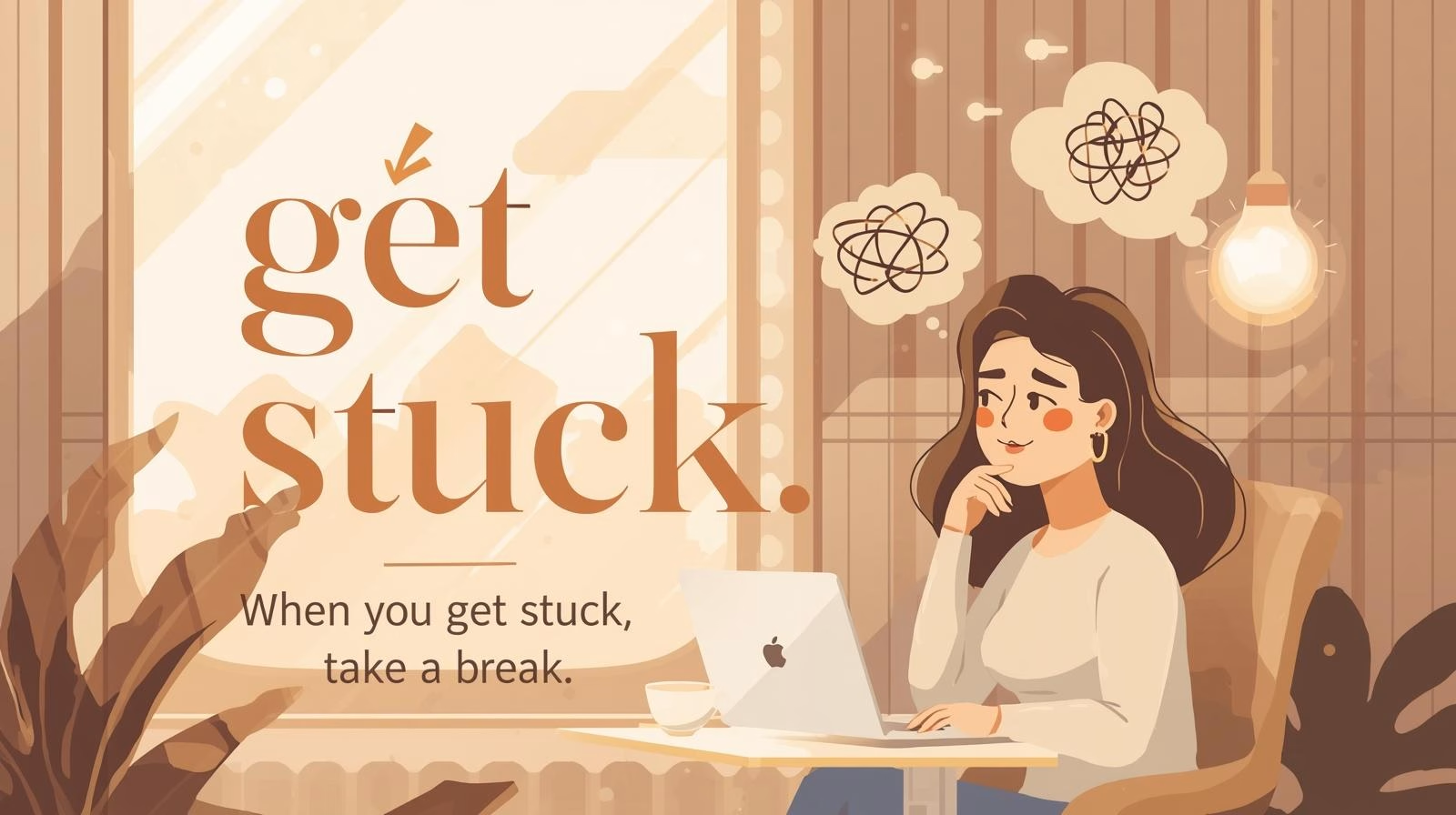
"I can't do it anymore... my brain isn't working!" Do you know how to express that feeling in English? Today's theme is "get stuck". This article will teach you the meaning, usage, and useful business examples of English expressions like "to be stuck" or "to be unable to move forward." Furthermore, we'll introduce items that can help reset your mind after getting stuck during desk work.
table of contents
table of contents
The meaning and basic usage of "get stuck"
Origin and etymology
Usage in everyday and business situations
A collection of frequently used chunks
Breo Hot Eye Mask: From "stuck" to "flow"
Differences from similar expressions
Let's try making some example sentences.
Summary
1. Meaning and basic usage of "get stuck"
"Get stuck" is an expression that means "to become unable to move," "to get stuck," or "to be unable to get out." A literal translation would be "to stick together and be unable to separate." From there, it has come to be used to mean "to be stuck in a rut," "to be stuck in traffic," or "to be unable to get out of a problem."
Example:
I got stuck in traffic this morning. (I got stuck in traffic this morning.)
I got stuck on this report for hours. (I was stuck on this report for hours.)
★ "Stuck" is the past participle of "stick" (to stick), and can also be used as an adjective (I'm stuck!).
2. Origin and Etymology
The word "stuck" originates from the Old English word "stician" (to pierce or thrust).
From there, the metaphorical meanings of "being stuck and unable to move" and "sticking together and not being able to separate" were born, leading to the idea of "being unable to move forward."
There are records indicating that the phrase was already used in Middle English to mean "unable to escape a difficult situation."
Furthermore, etymologically, "stick" means "something that is sticky" or "something that holds something in place," and in everyday life, the concept of being unable to move or being fixed in place has been derived from many expressions such as "stick to a plan" and "sticky situation."
Furthermore, the verb "get" in "get stuck" indicates a change, meaning "to become that state," and naturally conveys the nuance of "being unable to move (as a result)." Therefore, it has a stronger sense of process than "be stuck" and is suitable for conveying the feeling of "getting stuck without realizing it."
★ In modern English, this word can be used for any kind of "blockage," including emotions, work, relationships, and thoughts. In English, it's a useful word that goes beyond mere physical stagnation and can express mental aspects such as "stagnation of thought" and "emotional blockage."
3. How to use it in everyday and business situations
Conversation at a cafe: A: How's your presentation going? B: Ugh, I'm totally stuck on the opening part. (Hmm, I'm completely stuck at the beginning.)
At the office:
We got stuck in a long meeting again. (I'm stuck in another long meeting.)
Our project got stuck because of a budget issue. (The project is stalled due to budget issues.)
While traveling:
During our ghost tour in Kyoto, our guide got stuck in the middle of a spooky story because his flashlight went out. (During a ghost tour in Kyoto, the guide's flashlight went out, and the ghost story got interrupted.)
In the IT industry:
I'm stuck on this bug right now, and it's driving me crazy. (I'm completely stuck on this bug right now, and it's giving me a headache.)
The system got stuck during deployment, but we fixed it in time. (The system crashed during deployment, but we managed to fix it in time.)
The update process got stuck halfway and needed a manual restart. (The update process stopped midway, requiring a manual restart.)
★ "Get stuck" doesn't mean "you're not trying hard enough," but rather "a sign to pause." In English, it's often used lightly and without self-blame.
4. A collection of frequently used chunks
get stuck in traffic: to get stuck in traffic Example: I got stuck in traffic on my way to work.
get stuck on a problem: to get stuck on a problem Example) I got stuck on question 3 of the test.
Get stuck with paperwork: Can't escape from paperwork. Example: I got stuck with tons of paperwork.
get stuck in a loop: unable to break free from repeating the same mistakes. Example) I got stuck in a loop of overthinking.
★ Learning in chunks will allow English to come out of your mouth in "units."
5. From “stuck” to “flow” with the Breo Hot Eye Mask
There are moments at work when you think, "I can't do this anymore!"—that's exactly what it means to be "stuck." At times like these, you need time to reset your mind and eyes.
Featuring the latest graphene heating technology and air pressure function, it gently envelops the eye area, promoting blood flow and refreshing tired brains. Its 180° foldable design makes it easy to store, and the sound guidance ensures a relaxing experience for your mind as well.
When I get stuck after hours of screen time, I take a short break with my Breo eye massager. (When I get stuck after working on the screen for a long time, I take a break with my Breo eye massager.)
Warming the area around your eyes activates the parasympathetic nervous system, restoring brain performance. It's truly a switch that brings you back from "getting stuck" to "flow."
★ A 5-minute break can create focus for the next hour. Whether it's English or work, the golden rule is "reset when you get stuck."
I got stuck trying to follow a murukku recipe, but the result still tasted great! (I got stuck trying to recreate Muruk's recipe, but it turned out delicious!) ★ "Get stuck" is perfect for everyday situations like cooking. It's okay if it's not perfect; the important thing is to "enjoy the process."
6. Differences from similar expressions
be trapped: to be physically or psychologically confined (emphasizing a situation from which one cannot escape)
freeze up: becoming unable to move due to nervousness (e.g., an emotional "block" during a presentation).
get caught: to get involved in trouble or a situation (unable to escape due to external factors)
★ "Get stuck" is the most casual and versatile phrase that can be used naturally in conversation.
7. Let's try making some example sentences!
Let's think about situations in your workplace or daily life where you could use "get stuck."
When you're stuck on a project at work?
What to do when a discussion stalls during a Zoom meeting?
When does your motivation to learn English drop?
→ Try to describe that moment in English.
Example: I got stuck writing my report, so I took a break with a cup of coffee. (I wasn't making much progress on my report, so I took a break and had some coffee.)
Q&A: Frequently Asked Questions
Q1: Can "get stuck" be used in formal situations? A: It's basically a casual expression, but it's perfectly fine to use in business emails and meetings. If you want to be more formal, you can rephrase it as "encounter difficulties" or "face obstacles."
Q2: What is the difference between this and "be stuck"? A: "Get stuck" emphasizes the process of "coming into that state," while "be stuck" indicates "being in that state right now."
Q3: Can it also be used in a positive sense, like "getting hooked"? A: Yes. The phrase "get stuck into" means "to become engrossed in" or "to become absorbed in." Example: He got stuck into his new hobby.
8. Summary
"Get stuck" means "to be stuck" or "unable to get out of a rut."
It can be used in a wide range of areas, including thinking, work, and relationships.
The Breo Hot Eye Mask is a reset tool that brings you back from "stuck" to "flow."
"If it gets stuck, reset" = the most efficient way to restart.
Keep moving, even when you get stuck. (Even when you hit a dead end, keep moving forward little by little.)