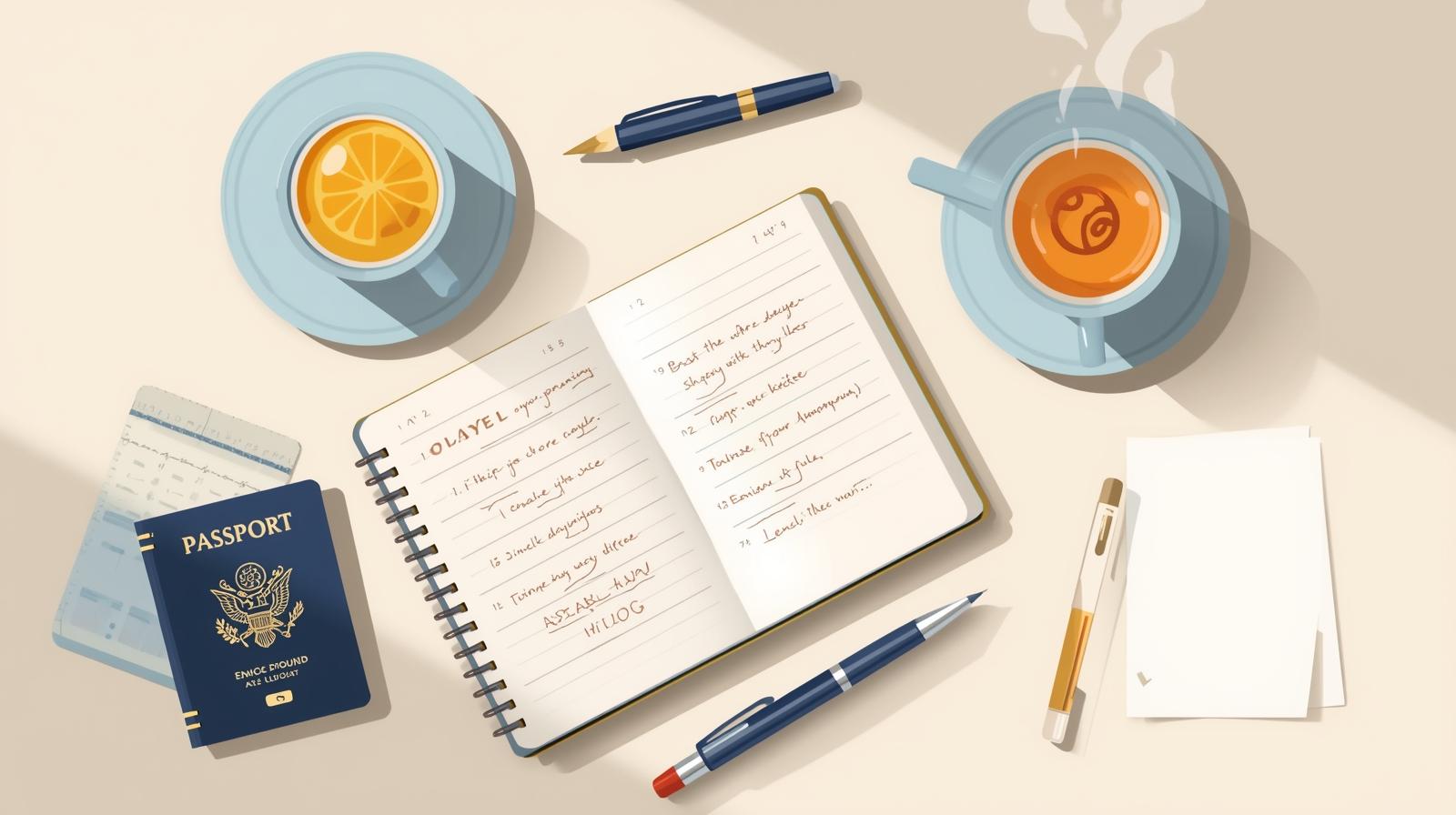
Movie ticket stubs, coasters from cafes received while traveling, wrapping paper that's too good to throw away—many people, regardless of country or language, probably have the feeling of these scraps of paper accumulating in the corner of their drawers.
Junk journaling is a craft where you gather those "paper items you can't bear to throw away" into a single book and create your own unique publication . In recent years, it has been quietly gaining popularity, mainly on English-language social media, and many videos of people creating junk journals have been posted on Japanese YouTube and TikTok.
This article provides a clear explanation of everything from the origin of the term to how it's actually used on overseas social media, and how to get started for beginners.
What you'll learn in this article
The meaning and origin of the term "junk journal"
Differences from scrapbooks and collages
How it's used on overseas social media and real-world English examples.
Tools and steps that even beginners can use to get started
Similar expressions in Japanese and their cultural background.
*This page contains promotional material.
table of contents
What is a "junk journal," a trending topic on overseas social media?
A junk journal refers to a notebook or book handmade using recycled materials or paper scraps. It involves binding and pasting together materials that would otherwise be discarded, such as envelopes, wrapping paper, pages from old books, ticket stubs, junk mail, and fabric scraps. The finished product can serve as a diary or photo album, and many creators consider it a work of art in itself.
There are no strict rules regarding the materials used; some people focus on writing, while others create collages with almost no text.
It is often said that the very fact that there are "no rules" is the core appeal of this craft.
The origin and history of the word – Why is it called "junk"?
The " junk " in the name doesn't refer to the quality of the finished product. It simply means that the materials used are "things that would normally be thrown away." They take scraps of paper that have little value on their own, such as magazine clippings and old stamps, and paste them together to create a cherished book. One creator describes this process as "turning junk into treasure."
From 19th-century scrapbooks to modern-day TikTok
The exact origin of the term itself—that is, who coined the term "junk journal" and when—is not clearly recorded. Multiple explanations agree that it did not appear suddenly, but rather evolved gradually from several older customs.
19th century scrapbookThe custom of pasting photographs, clippings, cards, etc., into a book to keep as a memento. This practice became popular among middle- and upper-class women.
Commonplace Book(commonplace book): An even older form of record-keeping, where quotations, poems, and notes are compiled into a single volume.
Altered Book(Altered book): A mixed media technique in which paint and paper are layered on the pages of old books to transform them into different works of art.
Building upon this history, the recent trend towards crafting using inexpensive paper products and discarded everyday items has shaped the current form of junk journaling. The term itself began to be widely searched in the late 2010s, and after sharing works on YouTube and Pinterest, its popularity on TikTok in recent years has attracted new creators.
The nature of the excitement varies from platform to platform.
Pinterest is used as a place to find inspiration for page layout and color schemes, while YouTube is used for longer production videos ranging from a few minutes to over ten minutes, as well as "flip-throughs" (videos showing the flipping through of a finished book), and is also gaining popularity as an ASMR/relaxing video where viewers can enjoy the sounds of turning pages and pasting. On the other hand, TikTok and Instagram Reels are dominated by short videos of less than a minute that quickly show the production process. Even for the same hobby, the current atmosphere is one where places for in-depth viewing and places for quick consumption coexist.
[Points to note] Criticism of "commercialization" happening behind the scenes of trends.
As the trend spread, a market for junk journaling materials also emerged. Numerous products are available, including paper pre-printed with an aged look, ephemera packs, and downloadable digital materials. While convenient, some overseas communities have expressed concerns that "what was originally a craft using discarded everyday items is now becoming a consumption-driven activity of buying specialized materials." The reality is that there's no single right answer to what constitutes "junk," as it's left to the individual creator's interpretation.
The difference between a junk journal, scrapbooking, and collage.
The question of "how is it different from collage or scrapbooking?" has been repeatedly asked in both Japan and English-speaking countries. The boundaries are fluid and there is considerable overlap, but the general trends can be summarized as follows.
Item
ジャンクジャーナル
スクラップブッキング
Collage (single work)
form
A handmade book made by binding together mismatched pieces of paper.
Pre-made albums and books serve as the base.
A two-dimensional artwork created by pasting onto a single sheet of cardboard.
Material
It mainly consists of unwanted items and leftover paper goods.
The focus is on photographs and souvenirs.
Materials for expression such as paper scraps and images
Main purpose
The joy of recording, expression, and the craft itself.
Organizing and preserving memories and events
Visual representation
Types and Rules
Almost none, high degree of freedom
There is a certain structure and style.
There is a composition, but it is free.
Relationship with memories
I also use materials that aren't limited to my own memories.
The focus is on the creator's own records.
Not necessarily a record
It's easiest to understand junk journaling as being focused on "organizing and preserving one's own records," whereas scrapbooks are more about "enjoying the materials themselves and turning them into a handmade book." To illustrate its place within a similar journaling culture, including bullet journals and collage journals, it would look like this:
English expressions and hashtags used on social media overseas
English-speaking communities have their own unique vocabulary and hashtags. Knowing a few of them will make understanding posts from overseas much easier.
It's not just #junkjournal! Related words you should know (Ephemera, etc.)
On social media, hashtags like #junkjournal and #junkjournalideas are well-established, and #junkjournalwithme is frequently used for posts showing the creative process. A double-page spread of a work is called a "spread," and a video showing the flipping through a completed book is called a "flip-through."
One of the most frequently used and essential keywords is " ephemera ." This term originally refers to disposable paper print materials such as tickets, train tickets, wrapping paper, old stamps, and receipts, and represents the very material used in junk journaling. Creators overseas commonly use phrases like "collecting ephemera" or "ephemera pack (material set)." Knowing this one word makes a big difference in how easily you can join conversations in overseas communities and is a key word for grasping the atmosphere.
Usage and examples in everyday conversation
In English, it can be used as both a noun and a verb. When referring to a single work, it's called "a junk journal," and when referring to the act of creating one or the hobby of junk journaling, it's called "junk journaling."
① I started a junk journal to use up all the ticket stubs I'd been keeping.
② She spends her weekends junk journaling at the kitchen table.
③ This whole spread is made from junk mail and old envelopes.
① is a noun referring to a book as a hobby, ② is a gerund representing the act of creation, and ③ is an example used in a context describing the materials used. In all cases, the underlying implication is "making something from everyday objects, rather than using special art supplies."
A simple guide to starting a junk journal for beginners
You can start with very simple tools: a notebook, glue or tape, scissors, and the paper you want to stick on. That's all you need to create your first page. In Japan, many people start with materials from 100-yen shops (such as Daiso and Seria), and the fact that you can try it with almost no initial cost is also appealing. The procedure is roughly as follows:
Gather materialsKeep things that catch your eye, such as tickets, receipts, wrapping paper, old letters, and magazine clippings.
Determine the foundationBecause the paper is layered thickly, notebooks or ring binders with ample room for expansion are easier to handle.
Choose a theme looselyTravel records, seasons, favorite colors, etc. This helps establish a framework for material selection and makes the creation process easier.
Start by pasting the background.Placing a larger piece of paper as a background can alleviate the oppressive feeling of the white margins.
Layer and decorateAdd depth using masking tape, stamps, lace, and handwritten lettering.
Writing is not mandatory. You can add text, or simply stick things on. Some creators enjoy the process of creating the materials themselves, such as "aging" recycled paper by dyeing it with coffee or tea to give it an aged look. It's not about competing for perfection, and the fact that you can work with a blank sheet of paper without hesitation is what makes it easy to continue.
Similarities with the uniquely Japanese aesthetics of "mottainai" and "mitate".
The term "junk journal" is used in Japan as a loanword, and works created using this term are widely posted on social media under names such as "junk journal" or "collage notebook." However, the underlying sensibility is not entirely new; it has a long-standing connection to Japan.
One aspect is the spirit of "mottainai" ( avoiding waste ). This attitude of finding value in things that are still usable and too precious to throw away, and trying to give them a new life in a different form, resonates with the idea of junk journaling, which transforms unwanted items into materials.
Another aspect is the sense of reinterpretation . The ability to see something as something of different value: the perspective of reinterpreting wrapping paper as background paper, or ticket stubs as proof of a journey, has long been deeply rooted in Japanese aesthetics.
It shares some similarities with traditional crafts. Harimaze-byobu ( pasted folding screens ) are made by pasting various types of calligraphy, paintings, and textile fabrics onto a pair of folding screens, and originated from the custom of preserving them as mementos or records. No two are exactly alike, and in the sense of collecting fragments and binding them together on one surface to admire them, it offers a similar enjoyment to a junk journal.
Looking at the present day, similar approaches to journaling have already taken root in various places, such as collage journals where you paste your favorite papers into ready-made notebooks , sharing files where you organize small pieces of paper and exchange them with friends , and the culture of Traveler's Notebooks, which are based on the premise of free customization . Junk journaling can be said to be a craft that is a continuation of these.
Giving a new home to scraps of paper that were destined to be thrown away—this small reinterpretation is perhaps the reason why this craft continues quietly, transcending language and generations.
On X in English-speaking countries"Words that are actually gaining popularity right now",
We compile and deliver the data weekly.
This weekly membership compiles trending words on English-speaking platforms and analyzes the culture and context in which each word originated . We deliver a weekly summary of "living English" that you won't find in dictionaries, along with trend information from overseas markets for cross-border e-commerce sites.
Wire Intelligence
980 JPY(TAX+)/month
Weekly trend word analysis + trends in the cross-border e-commerce overseas market
What are the words that are currently gaining popularity in English-speaking countries?Weekly tally, explaining the culture and trends as well.
Cross-border e-commerce siteOverseas marketWe deliver the latest trends every week.
From the moment you join,All past issuesYou can read it.
If you have a note account, you can start reading immediately. You can cancel anytime.
ADVERTISEMENT
🇯🇵 Your Japanese language skills can earn you money worldwide.
The number of Japanese language learners is rapidly increasing overseas. No qualifications are required, registration is free, and you can teach at your own pace. Already, learners in over 150 countries worldwide are using italki to learn Japanese.
Apps teach vocabulary. Real teachers teach you to speak. On italki, you can book 1-on-1 lessons with native Japanese tutors from just a few dollars — no subscription needed. Trusted by learners in 150+ countries.