Have you ever seen the phrase "Lock in" on social media or YouTube?
I'll be honest.
When I first saw this phrase, I thought, "Do I have to lock the door? Lock myself in my room?"
But it seems the reality is quite different.
Gym videos, pre-exam posts, sports highlights—the phrases "Lock in" and "I'm locked in" were everywhere, and once I learned what they meant, it all suddenly made sense.
Have you ever seen the phrase "Lock in" on social media or YouTube? If you have a general idea of what it means but aren't sure exactly, this article will clear up that confusion.
The slang meaning of "Lock in"
Why is it being used so much now?
Actual examples and usage
Trends as of February 2026, as seen through data
We will provide a thorough explanation.
*This page contains promotional material.
table of contents
Meaning of "Lock in"
As slang, "lock in" means "to concentrate completely," "to go into serious mode," or "to shut out all distractions and dedicate all your energy to one thing."
The closest Japanese equivalents would be "to switch on," "to get into the zone," or "to give it your all."
The key point is that it has a nuance that is a step above simply "trying hard" or "concentrating." It refers to "a state of complete immersion, shutting out everything else."
Usage patterns
Used as a verb
I need to lock in and study for the exam.
It's time to lock in.
Represents a state
I'm locked in. (Completely focused.)
She's locked in right now. Don't distract her.
As a call to action
Lock in! What are you doing?
Bro, lock in. (Hey, give it your all.)
Example sentences for different situations
Studying/Working
I have a big test tomorrow. I'm locking in tonight.
We need to lock in this week and finish the project.
In sports games
The team switched gears in the second half and dominated.
I'm locked in. Nobody can beat me right now.
In social media and everyday conversations
No plans this weekend. Just locking in.
It's winter arc season. Time to lock in.
Why is "Lock in" trending now?
The term "Lock in" was originally used in the context of games and military affairs, but it spread rapidly after Gen Z and Gen Alpha started using it on social media.
The underlying reason is a reaction against the "soft life" (an easy way of life).
Between 2023 and 2024, values such as "don't push yourself too hard" and "prioritize relaxation" became widespread, but from 2025 onwards, as a backlash, terms like "discipline" and "lock in" are rapidly gaining popularity among young people.
The use of "lock in" alongside early morning gym videos, study time-lapses, and "no excuses" captions has become a lifestyle movement.
In the fall of 2025, Fortune called this "The Great Lock-In," highlighting it as a phenomenon in which Gen Z is redefining hustle culture in its own unique way.
📊 Data-driven trends in "Lock in"
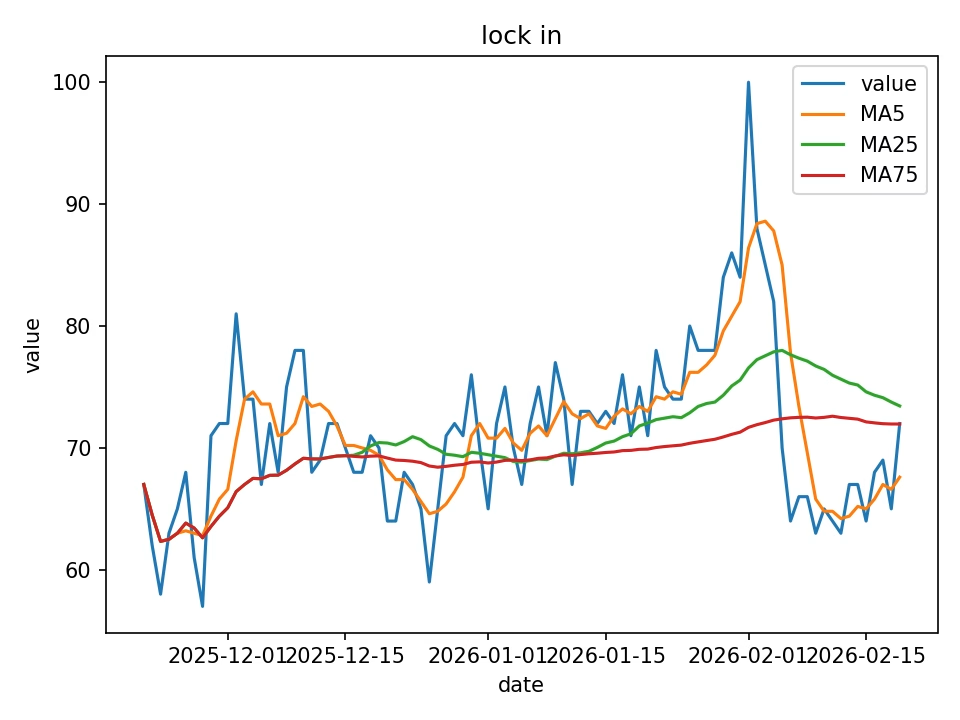
This graph uses Google Trends data and our site's proprietary system to calculate trend scores daily.
There are three key points to note.
① In early February 2026, the surge in value (actual data) temporarily reached 100. This is the maximum value recorded by Google Trends, and it represents a level where "there will be no higher search volume."
② The MA25 (Medium-Term Moving Average) has risen to approximately 78, with the average for the past three months reaching an all-time high. This indicates that it is not just a temporary buzz, but is attracting continuous attention.
③ The MA75 (long-term moving average) is also on an upward trend, and the long-term trend over the past three months is also rising. "Lock in" is an expression that is becoming established.
Now is the perfect time to use this word in articles, shorts, and social media posts.
What is the difference between this and "Locked in"?
Lock in(Verb) → The act or intention of entering a state of concentration.
Locked in(State) → Already in a state of concentration
Locking in(Present tense) → I am currently in the process of entering a state of intense concentration.
There's a subtle difference in nuance between "I'm going to lock in" (I'm about to get serious) and "I'm locked in" (I'm completely focused).
Comparison with similar expressions
Performance
meaning
Nuance
Lock in
Entering serious mode
Strong willpower / sense of being in the zone
Focus
Concentrate
Suitable for both casual and formal occasions.
In the zone
Entering the zone
Describes a state or condition; frequently used in sports.
Grind
Just keep working hard
Long-term effort
In the cap
Honestly, no lies
Emphasizing the sincerity of the statement
The phrase "lock in" is particularly characterized by a strong nuance of the moment when one switches on or a short period of intense focus .
Points to note when using
This is a casual expression, so avoid using it in business emails or when addressing superiors.
Note that in a business context, "lock in a contract" has a different meaning.
It can be used naturally in the context of social media, conversations with friends, sports, and games.
Summary
"Lock in" = to enter serious mode, to concentrate completely
This slang was popularized by Gen Z and Gen Alpha, and is now established worldwide.
The upward trend can also be confirmed with data from February 2026.
It can be used in a wide range of situations, such as the gym, studying, playing games, and working.
I personally think that "lock in," while an English expression, is a phrase that gives you a kind of push or encouragement. It gives you the feeling of, "Okay, let's cut out all the unnecessary things and focus solely on this." It's a word that's hard to find in Japanese.
The next time you need to give it your all, try saying "lock in" to yourself.
advertisement
English Trend Wire
On X in English-speaking countries"Words that are actually gaining popularity right now",
We compile and deliver the data weekly.
This weekly membership compiles trending words on English-speaking platforms and analyzes the culture and context in which each word originated . We deliver a weekly summary of "living English" that you won't find in dictionaries, along with trend information from overseas markets for cross-border e-commerce sites.
Wire Intelligence
980 JPY(TAX+)/month
Weekly trend word analysis + trends in the cross-border e-commerce overseas market
What are the words that are currently gaining popularity in English-speaking countries?Weekly tally, explaining the culture and trends as well.
Cross-border e-commerce siteOverseas marketWe deliver the latest trends every week.
From the moment you join,All past issuesYou can read it.
If you have a note account, you can start reading immediately. You can cancel anytime.
ADVERTISEMENT
🇯🇵 Your Japanese language skills can earn you money worldwide.
The number of Japanese language learners is rapidly increasing overseas. No qualifications are required, registration is free, and you can teach at your own pace. Already, learners in over 150 countries worldwide are using italki to learn Japanese.
Apps teach vocabulary. Real teachers teach you to speak. On italki, you can book 1-on-1 lessons with native Japanese tutors from just a few dollars — no subscription needed. Trusted by learners in 150+ countries.