Every year on March 17th, the world turns green. This day, celebrating Ireland's patron saint, is now one of the biggest cultural events in the English-speaking world. Let's learn everything from its historical background to practical English phrases you can use on social media.
*This page contains promotional material.
📅
What kind of day is St. Patrick's Day?
St. Patrick's Day is a public holiday celebrated annually on March 17th, commemorating the death of St. Patrick, the patron saint of Ireland. Originally a Catholic religious day, it has grown significantly in the United States, Canada, and Australia, which have large Irish immigrant populations, and is now established as a global festival where people "wear green, toast, and enjoy Irish culture."
In New York, a parade attracts over a million participants every year, and the hashtag #StPatricksDay trends globally on English-language social media. In Japan, Irish pub events are held in various locations, and awareness of the holiday is increasing year by year.
English trivia:
The correct abbreviation is "St. Paddy's Day." "Paddy" comes from "Pádraig," a nickname for Patrick in Irish. Be careful not to write it as "Patty"!
????
Historical Background – Who was Saint Patrick?
Patrick was a 5th-century Christian missionary. Born in Roman-ruled Britannia (present-day Great Britain), he was kidnapped and enslaved by Irish pirates at the age of 16. After six years of slavery, he escaped and later returned to Ireland to spread Christianity.
385
Born in the Roman province of Britannia, into a wealthy landowning family.
401
He was kidnapped by Irish pirates and spent six years as a slave, working as a shepherd.
407
He successfully escaped. He returned to Britannia and received an education as a clergyman.
432
He returned to Ireland as a bishop and began spreading Christianity. He is said to have used the three-leaf clover to preach about the Trinity.
March 17, 461
Patrick died. This anniversary of his death is the origin of "Saint Patrick's Day."
1631
It was officially designated as a public holiday by the Catholic Church.
1737
Boston will host the world's first St. Patrick's Day parade.
1900s to present
With the increase in Irish immigration, it developed into a national event in America. Now, parades are held in more than 50 countries worldwide.
☘
Let's learn the symbol of this day in English.
Why green? Why clover? Each of the symbols that adorn this day has a deep and meaningful origin.
☘️
Shamrock
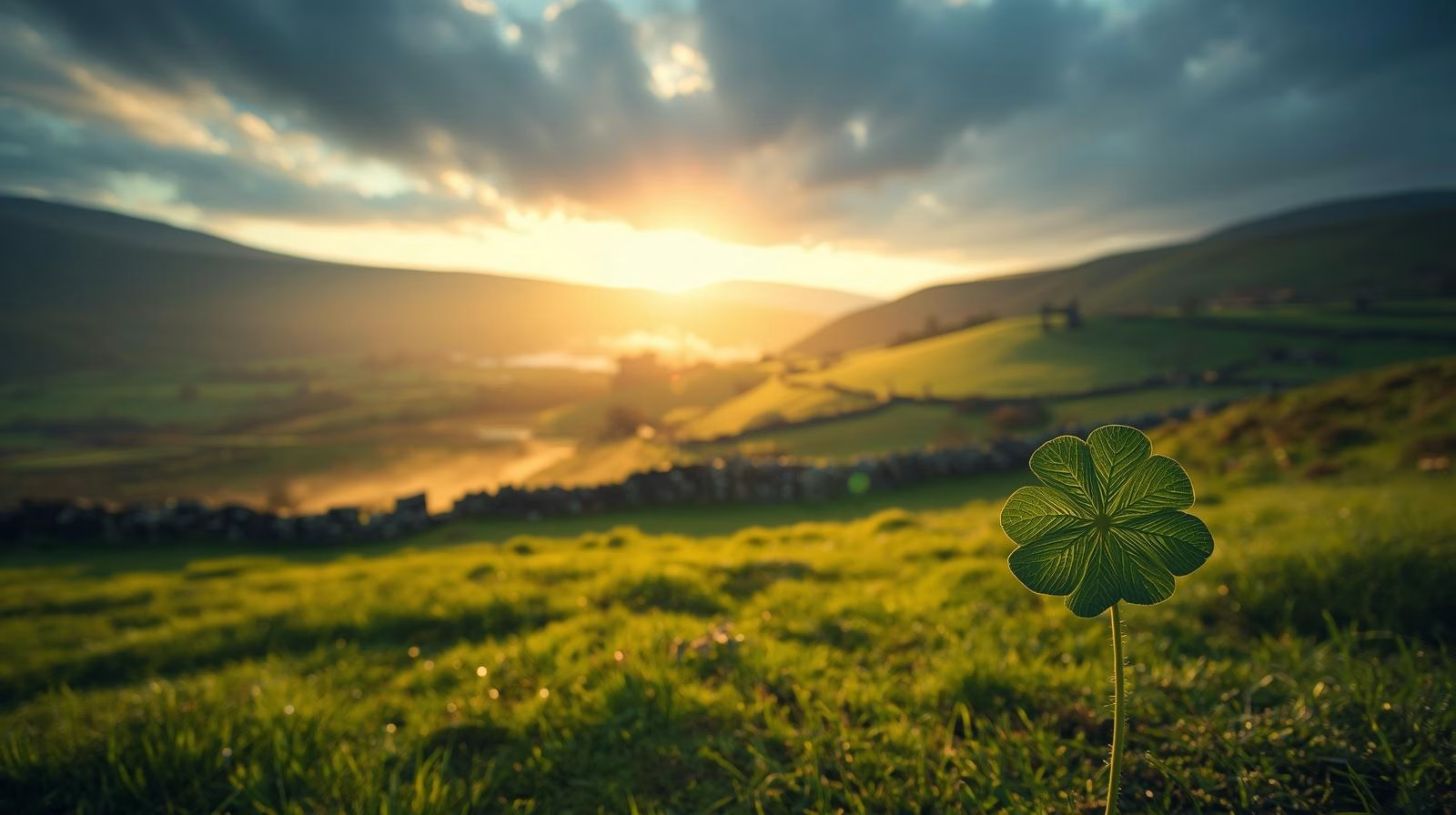
The three-leaf clover. It is said that Patrick used it to explain the Trinity of Father, Son, and Holy Spirit. It is a national symbol of Ireland.
💚
Wearing Green
The name comes from Ireland's alternative name, "Emerald Isle." There's also a legend that if you're not wearing green, you'll get pinched by a leprechaun!
🧙
Leprechaun
A green-clad fairy from Irish folklore, famous for the legend that she hides a pot of gold at the base of the rainbow.
🏆
Pot of gold
A golden vase. Believed to be hidden at the end of the rainbow, it is a symbol of "good fortune and wealth." It is often used in conjunction with the phrase "Luck of the Irish."
????
Celtic Harp
The Celtic harp is Ireland's most important symbol, even depicted on the Irish coat of arms. Live performances are a staple in Irish pubs.
🍺
Guinness
This is Ireland's quintessential stout. With an estimated 1,300 million pints consumed worldwide on this day alone, it's one of the most "English-speaking" symbols.
💬
A Complete Collection of English Phrases You Can Use Right Away!
This is a collection of phrases you can use with English-speaking friends, colleagues, and social media followers, categorized by situation. Start using them today!
▶ Greetings and congratulatory remarks
"Happy St. Paddy's Day!"
Happy St. Patrick's Day! This is the most casual and easy-to-use classic expression.
“Wishing you the luck of the Irish!”
Good luck in Ireland! A classic phrase used on postcards and cards.
“Sláinte!” (Slancha)
Cheers! It means "to be healthy" in Irish. A cool phrase that works even in English-speaking countries.
“May your day be filled with Irish charm!”
Have a day filled with the charm of Ireland. A slightly more thoughtful congratulatory message.
▶ Expressions you can use in conversations and on social media
“Everyone's Irish on St. Patrick's Day.”
Today, everyone is Irish. This is a classic phrase that captures the festive atmosphere of a holiday where people of all nationalities celebrate together.
“Are you wearing green today?”
Are you wearing green today? This is a standard greeting for this day. It's often used in the workplace and school.
“I've got some Irish blood in me!”
I have Irish blood flowing through my veins! A fun and humorous expression to use.
“We're going bar-hopping tonight.”
Let's go bar hopping tonight. (Bar hopping = moving from one bar to another to drink. A typical activity for this time of night.)
“May the road rise up to meet you.
May the wind always be at your back.”
— A traditional Irish blessing. A common expression still used in cards and speeches. A literal translation is "Let the road spread before you; let the wind always push you forward."
[PR] Have you ever studied textbooks and attended classes, only to find that you can't understand native speakers when it comes down to it?
For those people, we recommend a learning material that allows you to learn "practical English," which has been highly praised by a professor at Kyoto University.
The most distinctive feature of this material is that approximately 150 Americans are speaking "without a script."
Instead of overly polished recorded audio, you can learn the "real speed" and "natural expressions" that you actually hear spoken in cafes and hotels.
It's produced by the team that created bestsellers at KADOKAWA, and the fact that you can easily play it on your smartphone is a major plus.
If you're someone who can't study abroad but wants to develop practical listening skills that will be useful in a foreign country, then you should definitely check this out.
🌍
A day when the whole world turns green - Trivia you should know
St. Patrick's Day is now more than just an Irish holiday; it's a global pop culture event.
Chicago's rivers turn green
Every year, the Chicago River is dyed with an environmentally friendly green dye. This tradition, which began in 1962, has now become a globally iconic symbol of St. Patrick's Day.
Landmarks around the world turn green
Landmarks around the world, including the Empire State Building, the Sydney Opera House, the London Eye, and Tokyo Tower, will be lit up in green.
In Ireland
Because it was once a religious holiday, pubs in Ireland were legally closed until the 1970s. Now, a four-day national cultural festival called "St. Patrick's Festival" is held.
Guinness consumption
It is estimated that approximately 13 million pints (about 74 billion ml) of Guinness are consumed worldwide on this day alone. This is about three times the normal consumption.
Cultural comparison notes:
American St. Patrick's Day is also a "cultural of immigrants" created by Irish immigrants. For many years, it was celebrated more extravagantly in America than in Ireland, a reversal of the usual pattern. This is similar to how Valentine's Day in Japan developed independently in Japan rather than in Europe.
🇧🇷
Summary – Things you can start doing today
St. Patrick's Day is a great opportunity to "learn English through culture." On this day alone, unique slang and phrases fill English-speaking social media, and you can encounter expressions specific to Irish English.
Just knowing the phrase "Sláinte!" can make conversations with your foreign friends so much more engaging. Start today on X or Instagram. #StPatricksDay Try searching for it. You'll find tons of real posts from native English speakers, which should make it an excellent learning resource.
Today's actions:
On social media “Happy St. Paddy's Day! 🍀 #StPatricksDay” Try posting it. You can expect responses from English-speaking users, making it excellent practice for outputting your thoughts.
“The best way to predict your future is to create it.”