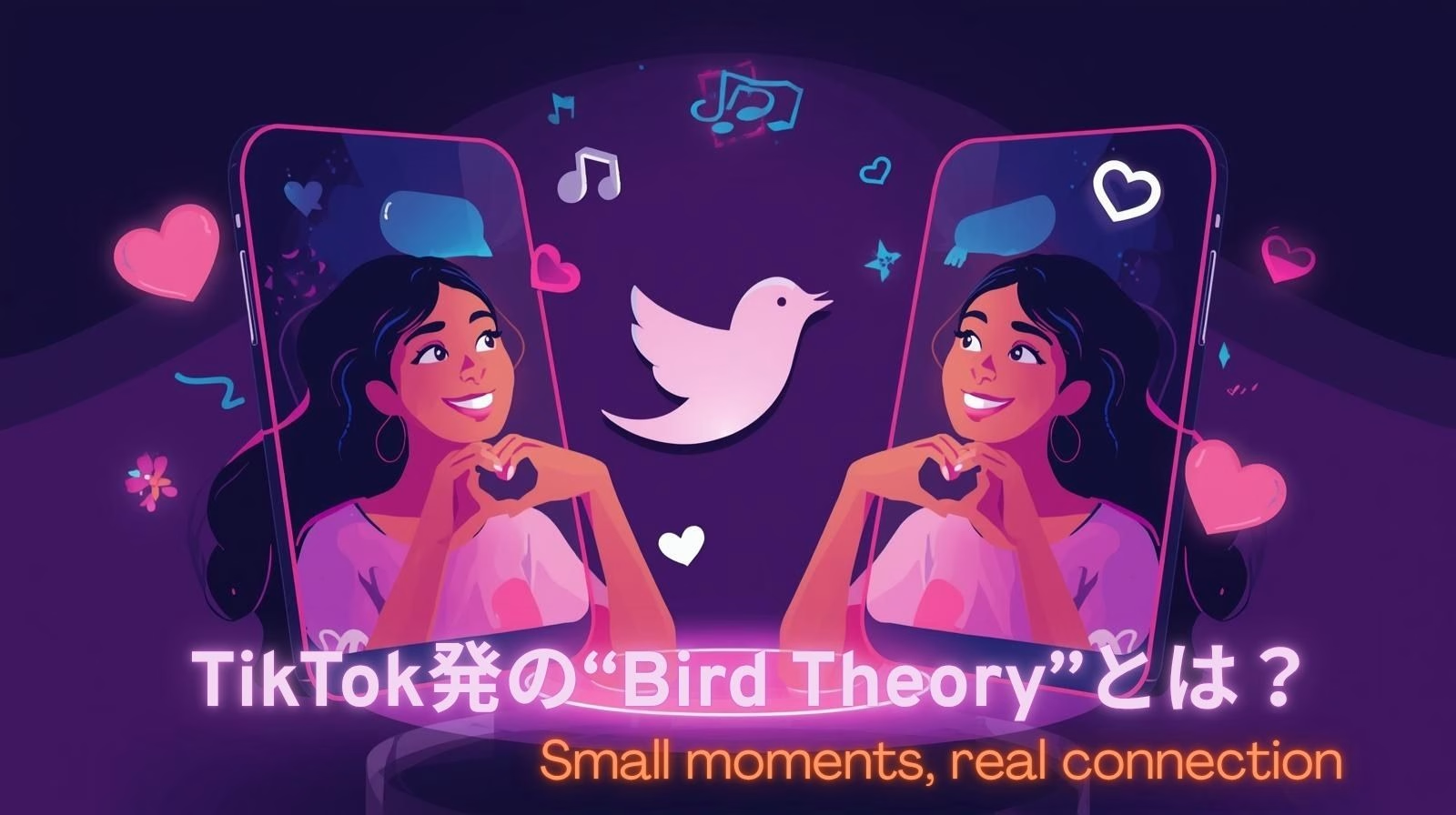
Small, everyday moments can be the key to deepening connections with others.
The "Bird Theory" is a prime example of this way of thinking.
This phrase, which spread rapidly on social media, asks us, "What is true empathy?"
For example, when you point to a bird you see in the park in the morning and say, "It's cute," and the other person smiles—you feel like you've grown a little closer. It's in moments like these that understanding transcends words.
What you will learn from reading this article:
The meaning and background of the trending English term "bird theory"
The origin and history of this word
How to use it in everyday life, relationships, and work.
A collection of English chunks you should remember.
*This page contains promotional material.
table of contents
What is this "Bird Theory" that's been getting a lot of attention lately?
"Have you recently had a laugh with someone over something completely trivial?"
On social media, a way of thinking that captures such everyday moments, known as "Bird Theory," is gaining attention.
On TikTok, "#birdtheory" became a trending topic, and it began to be discussed in a wide range of contexts, from romance and friendship to teamwork.
When I first saw this phrase myself, I thought, "Oh, this must be that moment when you're at a cafe with a friend and you both laugh and say, 'Isn't that girl cute?'"
Yes, the ability to share casual, small topics is a sign of trust and closeness...that's the essence of "bird theory."
The meaning and background of "Bird Theory": Why birds?
The basics of "Bird Theory" are simple.
If you can talk about birds with someone, that's your person. (Someone you can talk to about birds casually is the "person" you need.)
Here, "bird" doesn't refer to an actual bird, but rather symbolizes the "comfort of being able to share trivial things." Sparrows in the city, clouds in the sky, music in a cafe—these small topics create a "thread of empathy" that transcends words.
One day, while I was resting on a bench in a nearby park, an elderly man sitting next to me said, "There seem to be a lot more Japanese white-eyes in this park lately." That one comment naturally led to a conversation, and I remember feeling that an ordinary afternoon had become a little more special. It was truly a moment of "bird theory."
In psychology, this is called "shared attention," and it is believed that empathy and trust are born when people focus their attention on the same object as others.
The reason it went viral on TikTok and X
This theory became widespread in the latter half of 2024.
It all started when a TikTok user posted, "The moment I laughed with him while watching birds, I felt like this was a real connection." The video has been viewed millions of times, and the comments section is flooded with people saying things like, "That's my bird theory moment!"
This concept has spread not only to romantic relationships but also to friendships and workplace relationships, and has become established as a term symbolizing "authentic connection."
The origin and history of the term "Bird Theory"
The term "Bird Theory" is a relatively new name that originated on social media, but the underlying idea has its roots in psychological research from the 1990s.
John Gottman, a leading authority on relationship research, proposed the "bid for connection" theory, which suggests that how one responds to small cues thrown by the other person—for example, "Look at that child!"—is strongly related to predicting trust and satisfaction. In a long-term follow-up of newlywed couples, Gottman showed that the higher the rate at which one "turns toward" everyday bids, the more stable the relationship tends to be.
The flow of spread as seen on the timeline
1990s: Gottmann's experiments and follow-up studies scientifically supported the importance of "bids."
2010s: The concept of "bids for connection" spread through books, lectures, and blogs aimed at the general public, and became established as a fundamental concept in couples therapy.
Autumn 2023: The term "Bird Test" spread on TikTok. Short videos of people pointing at birds and observing their reactions went viral.
2024-2025: The term "Bird Test" expands in meaning to "Bird Theory." It is used not only in the context of romantic relationships, but also as a metaphor for measuring relationships through "small, easily shareable topics" such as friendships, family, and colleagues.
The difference between "Test" and "Theory"
Bird Test: A term for an "instant check" to observe the reaction on the spot. Often produces good video footage.
Bird Theory: This is the name of a "way of thinking or principle" that states that small acts of shared attention significantly influence the quality of relationships. It emphasizes the cumulative effect rather than isolated incidents.
What is new, and what is classic?
What's new is the naming and the dissemination method (short videos), but what's classic is the content—the insight that "noticing and responding to small cues fosters relationships." Therefore, it's more practical to view "Bird Theory" not as a one-shot pass/fail test, but as an "attitude" that increases daily micro-interactions.
Supplementary information from the learner's perspective
This concept of "bid" can also be applied to learning English.
A short chunk of response to a casual remark from the other person (e.g., "Look, that cloud looks like a cat.")
"Oh, I see."
"Nice catch."
“Good eye.”
Having this ready will allow you to "turn toward" immediately.
In English, there is an idiom, "a little bird told me," and birds have long been symbols of carrying "insights" or "whispers."
How it's actually used in English-speaking countries
On social media, the term "bird theory" is used naturally in everyday conversation.
“He noticed the same bird as me. That's how I knew he was my kind of person.” (The moment we noticed the same bird, I knew we had something in common.)
“We don't need deep talks, just bird theory moments.” (No need for deep conversation. Just a moment of bird theory is enough.)
When I was doing a homestay in America, I remember laughing with my host family after dinner in their yard about how there were an awful lot of squirrels in this town. Even if your English isn't perfect, sharing small observations like that can bring you closer.
What's the equivalent feeling in Japanese? Similar expressions
"Bird theory" in Japanese has nuances similar to "being on the same wavelength," "having the same taste," or "having a similar vibe." Seeing the same "bird" means "seeing the same world." It has a poetic sound, but it's actually a very human feeling.
For example, laughing together with a friend and saying at the same time, "That cafe music is great right now."
Sharing the same view and being moved by it while traveling...that kind of "shared awareness" is truly a "bird theory" moment. It's similar to the moments of shared understanding you might experience in a romantic relationship, like saying, "I was thinking the same thing!", or in the workplace, like saying, "I was just thinking that at the same time!"
Other similar expressions include "on the same wavelength" and "vibe with someone." These all arise naturally when you feel a "shared sense" during a conversation.
ADVERTISEMENT
🇯🇵 Your Japanese language skills can earn you money worldwide.
The number of Japanese language learners is rapidly increasing overseas. No qualifications are required, registration is free, and you can teach at your own pace. Already, learners in over 150 countries worldwide are using italki to learn Japanese.
Apps teach vocabulary. Real teachers teach you to speak. On italki, you can book 1-on-1 lessons with native Japanese tutors from just a few dollars — no subscription needed. Trusted by learners in 150+ countries.
A: “I told him about the little sparrow outside the cafe, and he smiled.” B: “That's pure bird theory right there.” (A: When I told him about the sparrows outside the cafe, he smiled. / B: That's bird theory for you.)
In English learning, it's important to be mindful of this "lightness." Instead of struggling to find topics, try sharing small things in English that are right in front of you—that might be the first step towards true communication.
A collection of expressions related to "bird theory" to learn in chunks.
notice the same thing.
share little moments
connect effortlessly (to communicate naturally)
sense of connection
That's so bird theory.
"Let's think about your own theory of Bird" workshop
What does "bird" mean to you?
・The music at your favorite cafe? ・Scenery seen while traveling? ・A joke you can relate to?
My friends and I often laugh when we order the same thing, and I think those moments are my own "bird theory." What is your "bird"?
Other English expressions using "bird"
There are many expressions in English that use the word "bird." Each reflects a different culture and emotion, and mastering them will greatly broaden your conversational range.
A little bird told me → A polite way of saying "I heard it from someone." Example: A little bird told me you got a new job.
The early bird catches the worm. → "The early bird catches the worm." A proverb that praises the importance of early effort and action.
Birds of a feather flock together. → "Birds of a feather flock together." This means that people with similar values and personalities naturally gather together.
kill two birds with one stone → A standard expression used when one action yields two results.
free as a bird → A phrase that describes a state of freedom without restraint. Example: After quitting my job, I felt free as a bird.
What all these expressions have in common is that "bird" is used as a symbol of freedom, lightness, and intuition.
Q&A: Frequently Asked Questions
Q1. Is "Bird Theory" a way of thinking that applies only to romance? No. This applies not only to romantic relationships, but also to friendships, family, and workplace relationships. The important thing is whether or not you have "small moments to share."
Q2. What is the difference between this and the "Bird Test"? The "Bird Test" is closer to a "check" to observe the other person's reaction on the spot, while "Bird Theory" is a "way of thinking" that emphasizes the accumulation of everyday experiences.
Q3. How can this be used in English language learning? This is a great way to practice sharing small observations in English during conversations. Use short phrases like "Look at that bird." or "That cloud looks funny." to increase your natural interactions.
Summary: What birds teach us about "the right distance in human relationships"
The "Bird Theory" is the idea that "small acts of empathy" connect people.
Birds are symbols of freedom and naturalness.
The reason it resonated with people on social media is that it reflects modern people's longing for "casual connections."
In conversation, saying "That's the bird theory" naturally conveys the message, "We think alike."
The essence of words lies in "feeling," which transcends meaning. If you notice a little bird at the cafe today, that might be the start of your "bird theory."
Keep noticing the little things — that's where true connection begins.
advertisement
English Trend Wire
On X in English-speaking countries"Words that are actually gaining popularity right now",
We compile and deliver the data weekly.
This weekly membership compiles trending words on English-speaking platforms and analyzes the culture and context in which each word originated . We deliver a weekly summary of "living English" that you won't find in dictionaries, along with trend information from overseas markets for cross-border e-commerce sites.
Wire Intelligence
980 JPY(TAX+)/month
Weekly trend word analysis + trends in the cross-border e-commerce overseas market
What are the words that are currently gaining popularity in English-speaking countries?Weekly tally, explaining the culture and trends as well.
Cross-border e-commerce siteOverseas marketWe deliver the latest trends every week.
From the moment you join,All past issuesYou can read it.