It actually originated in Europe — We'll explain the reason behind the awkwardness of pressing "No Tip" at Starbucks.
If you've ever been to America, haven't you ever felt confused at this moment?
The meal is over and the bill arrives. There's a "Tip" section. 15%? 18%? 20%? Have you ever had the experience of glancing at the next table, doing some calculations on your smartphone, and then ending up writing down a random amount without really understanding it?
Why do we tip in the first place, and when did it start? And to be honest,How much do I have to pay?.
This time, I'd like to delve deeply into all of these topics.
*This page contains promotional material.
table of contents
Tips didn't originate in America.
Let's start with a surprising fact.
While tipping culture is often associated with America, its origins actually lie in Europe—17th-century England.
A commonly heard theory about its etymology is that it's an acronym for "To Insure Promptness."
This is considered almost entirely an urban legend. There is no linguistic basis for it, and furthermore, "ensure" is considered the correct spelling rather than "insure."
The true etymology is much simpler, coming from the English slang verb "tip" (to hand over discreetly). Records show that in 17th-century London coffee houses, customers would tip waiters, or discreetly hand over small change.
Incidentally, tips back then weren't something you paid after the meal. You'd give them in advance to ask for things like "Please seat me at a good table" or "Please bring the food quickly ." It wasn't an expression of gratitude, but rather an upfront investment in service—similar to buying VIP treatment today.
Why has it become so deeply rooted in America?
This custom, which spread from Europe to America in the 19th century, was initially met with strong opposition from Americans.
Based on the logic that "it's wrong to give charity to people in a democratic country," the " Anti-Tipping Society of America" was even formed in 1904. It seems that members pledged never to tip.
So why has tipping become commonplace in America today?
The catalyst was the period after the American Civil War.
When freed Black laborers were hired as railroad porters and waiters, employers began to use the logic that " we can make money from tips, so wages don't need to be high ." Tips became entrenched in society not as a sign of gratitude, but as a mechanism to justify low wages .
What seems like the origin of a beautiful culture actually has a rather complex history.
New problems of the 2020s Tip creep
A phenomenon that has recently become a hot topic in the United States is called " tip creep."
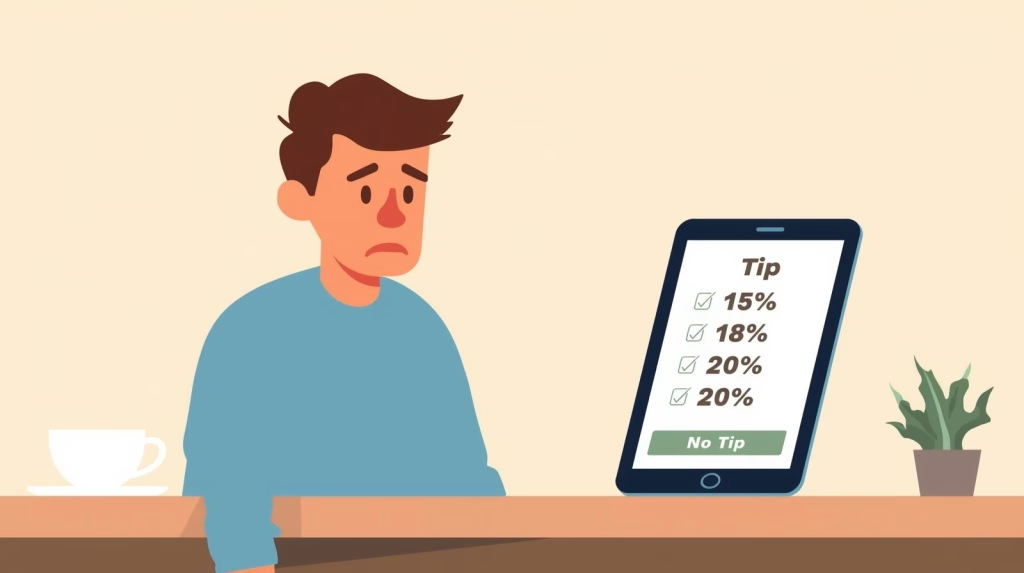
Tipping used to be expected only in restaurants and hotels. But now, you can order at a coffee shop using a touchscreen and a screen will pop up suggesting a 15-25% tip. Even for takeout orders and at unmanned kiosks.
Consumer dissatisfaction is so high that American media outlets are calling it " tipping fatigue." But refusing a tip feels awkward...this social pressure makes it even harder to decline a tip.
Those who know what I mean will understand the awkwardness of ordering at Starbucks and having to press "0%" while looking at the screen with the barista.
(At checkout, the option for tipping was displayed on the monitor, and I was constantly under the watchful eye of the staff. Furthermore, the order wouldn't proceed unless I selected a tip.)
So, how much do I actually have to pay?
I think this is the part you're most interested in, so I'll write it down first.
📍 Market prices by location
situation
Indication
Restaurant (where you sit and eat)
Total amount 18~20% That is the current standard
Bar drinks only
$1/cup Or 15~18%
Cafe/Takeout
No need to pay(If I were to pay, it would be around $1)
Taxi/Uber
10~15%
Hotel bellboy
$1-2 per piece of luggage
hotel cleaning staff
$2-5 per night(Place it by your bedside every morning)
Hair salon
15~20%
Calculating a 20% restaurant tip is easier if you think of it as 1/5 of the total bill . (For example, a $45 meal would have a $9 tip.)
💳 Cash? Credit card? Which will you pay with?
If paying by credit card, a tip field will appear on the receipt or tablet; simply enter the amount or percentage there. This is the smoothest method.
Paying in cash is perfectly fine. In fact, cash tips are often appreciated because they go directly to the staff (card tips can be added to their salary and subject to taxation).
The basic custom is to leave cash on the table when you leave. To avoid giving the impression that you've forgotten, place it on top of the bill or near your plate.
☕ Should Starbucks and other major chains pay?
This is the most troublesome one.
You don't have to pay at counter-ordering chain stores like Starbucks and McDonald's.
However, in reality, when the options "15% / 18% / 20% / No Tip" appear on the screen, it feels awkward to press "No Tip" if the cashier is looking at you... apparently, even Americans feel this way.
In such situations, a practical solution is to either turn the screen slightly towards yourself before selecting , or to quickly tap without looking at the screen beforehand . There's absolutely no need to feel guilty about it.
🌍 What about outside of America?
Even within English-speaking countries, there are considerable differences from country to country.
United KingdomA guideline is 10-12.5%. These days, service charges are often automatically included.
AustraliaTipping is generally not required. However, if the service was good, a tip is appreciated.
Canada: Almost the same as in America. 15-20%
Japan: Not needed (in fact, it will likely be refused)
Useful English phrases for tipping while traveling
We will also introduce some commonly used English expressions related to tipping. Just knowing these phrases will make interactions with locals much smoother, and it's a great opportunity to use them.
💬 Keywords related to tipping in English
tip and gratuity — both are pronounced "tip," but they have slightly different nuances.
typeA casual word used in everyday conversation. It can also be used as a verb (e.g., "Did you tip the driver?").
gratuityThis phrase is used in formal situations and written communication. It often appears on receipts and contracts ("Gratuity not included" = tip is separate).
📋 Phrases you often see in restaurants
English Expressions
meaning
Scenes that appear
Gratuity not included
Tips are not included.
Notes on receipts and menus
Service charge included
Service charge included
Often seen in large groups
Suggested tip: 18% / 20% / 22%
Recommended tip amount
Tablet Accounting
Add tip?
Would you like to add a tip?
Card payment terminal
No-tip / Decline tip
No tip
Select button
Custom amount
Enter the amount yourself
When you want to insert any percentage
🗣️ Practical conversation phrases
When giving a tip (at hotels, taxis, etc.)
“This is for you. Thank you so much.” "This is for you. Thank you so much." *Simply handing it over is fine. Adding a short message will make them happy.
When the service was exceptionally good
“You were wonderful. I'll make sure to leave a good tip.” "That was excellent service. I'll leave a generous tip."
When to refuse a tip (rare cases)
"No tip, thank you." This is all you need to do. No need for a long explanation.
When you want to check if a chip is already included
“Is the gratuity already included?” "Is the tip already included?" *It's wise to check beforehand, especially when dining with a large group or at a high-end restaurant.
🧠 Other tipping expressions used in everyday life
“to tip well” / “to recommendably” → To tip generously, to pay generously
"He always tips well at his regular spots."
“a bad tipper” / “a cheap tipper” → Someone who is stingy with tips (this is quite an insult in America)
It's commonly used among Americans. "He didn't give a good tip" is a normal phrase you'd hear in everyday conversation.
“Tip scratch” → The phenomenon of situations where tips are expected is increasing. As mentioned in the article, this itself has already become a slang expression that has become established in the media.
“guilt trip screen” → A sarcastic term referring to payment terminals that create psychological pressure to make it difficult to refuse tips. Literally translated, it means "guilt screen." It is often used in American comedies and on social media.
✍️ Quick note
When trying to understand tipping culture in English, you'll notice that the word "tip" can freely transform into a verb, noun, and adjective.
noun:“Leave a tip.”(Leave a tip)
verb:"Did you tip?"(Did you pay a tip?)
adjective:“tip-included price”(Price includes tip)
It's interesting how in English, you can often convey everything with just one word in situations like this. In Japanese, you need a verb, such as "to pay a tip" or "to give a tip," but in English... “tip” It can be said in one word.
Gap with Japanese sensibilities
In Japan, it's taken for granted that "the cost of the service is already included in the price." Even if you receive excellent service, you don't need to pay extra; that's the norm.
On the other hand, in the US, the hourly wage for service staff can be as low as $2-$3 in some states (there are exceptions to the minimum wage).
Because the salary system is based on the expectation of tips, not paying a tip sends the message that "the service was poor."
It's not a matter of which is right or wrong; the systems are fundamentally different —simply understanding that might make you feel a little more at ease about tipping.
The next time you get your bill at an American restaurant, try calculating the 20% tax while keeping in mind that "behind this culture lies the labor issues of 17th-century London and the aftermath of the Civil War."
“Travel is fatal to prejudice, bigotry, and narrow-mindedness.” — Mark Twain
advertisement
English Trend Wire
On X in English-speaking countries"Words that are actually gaining popularity right now",
We compile and deliver the data weekly.
This weekly membership compiles trending words on English-speaking platforms and analyzes the culture and context in which each word originated . We deliver a weekly summary of "living English" that you won't find in dictionaries, along with trend information from overseas markets for cross-border e-commerce sites.
Wire Intelligence
980 JPY(TAX+)/month
Weekly trend word analysis + trends in the cross-border e-commerce overseas market
What are the words that are currently gaining popularity in English-speaking countries?Weekly tally, explaining the culture and trends as well.
Cross-border e-commerce siteOverseas marketWe deliver the latest trends every week.
From the moment you join,All past issuesYou can read it.
If you have a note account, you can start reading immediately. You can cancel anytime.
ADVERTISEMENT
🇯🇵 Your Japanese language skills can earn you money worldwide.
The number of Japanese language learners is rapidly increasing overseas. No qualifications are required, registration is free, and you can teach at your own pace. Already, learners in over 150 countries worldwide are using italki to learn Japanese.
Apps teach vocabulary. Real teachers teach you to speak. On italki, you can book 1-on-1 lessons with native Japanese tutors from just a few dollars — no subscription needed. Trusted by learners in 150+ countries.